Accessibility at Catholic Charities Boston
Program Description
Catholic Charities Boston is a nonprofit in Massachusetts that provides support to low income people. The center is located near public transportation, making it accessible to families in local communities. The program’s mission statement is “to build a just and compassionate society rooted in dignity and respect for all people.” The services they provide are food distribution, housing assistance, senior and youth services, and family support. The site I went to had different program areas, a food pantry, and staff offices. Staff and volunteers work together to serve diverse communities that speak different languages, including English, Spanish, and Portuguese.
Interview
This week I had the pleasure of interviewing Richard Gonsalves, a Program Coordinator at Catholic Charities Boston. He shared his perspective on inclusion and community building, as a Hispanic man who grew up in a low income household. He explained he feels a personal duty to make welcoming spaces because of his own experiences with discrimination. “That’s one of the main reasons I became a program coordinator here, to support families going through the same issues I went through,” he stated.
When asked about how the organization practices inclusion he replied “so our building is in a central area right next to the train station, and we are able to serve families in different communities. We also have ramps and offer extra assistance to people with disablities. In addition to English, other clients speak Spanish or Portugese and we have bilingulal staff that can help.”
When asked about strengths and areas for growth, Gonsalves noted, “I’d say some of my strengths are my compassion, dedication, and empathy. I really care about the people we help and work we are able to do in the community. Some areas for growth I have are my organizational skills and general company knowledge. I’ve only been working with Catholic Charities for a few months and I’m not fully familiar with all the services we provide.” His response fits with course concepts of bringing your own personal values into the company and making sure their missions align with your own. (Simmons& Patterson, 2020).
He also stressed the importance of inclusivity, “I make sure to provide extra support when needed for people with language barriers, disabilities, or limited resources. I do this by having attentive staff and volunteers that are trained to help.” This demonstrates an full understanding of inclusion not just physical but emotional responsiveness as well.
Building Accessibility
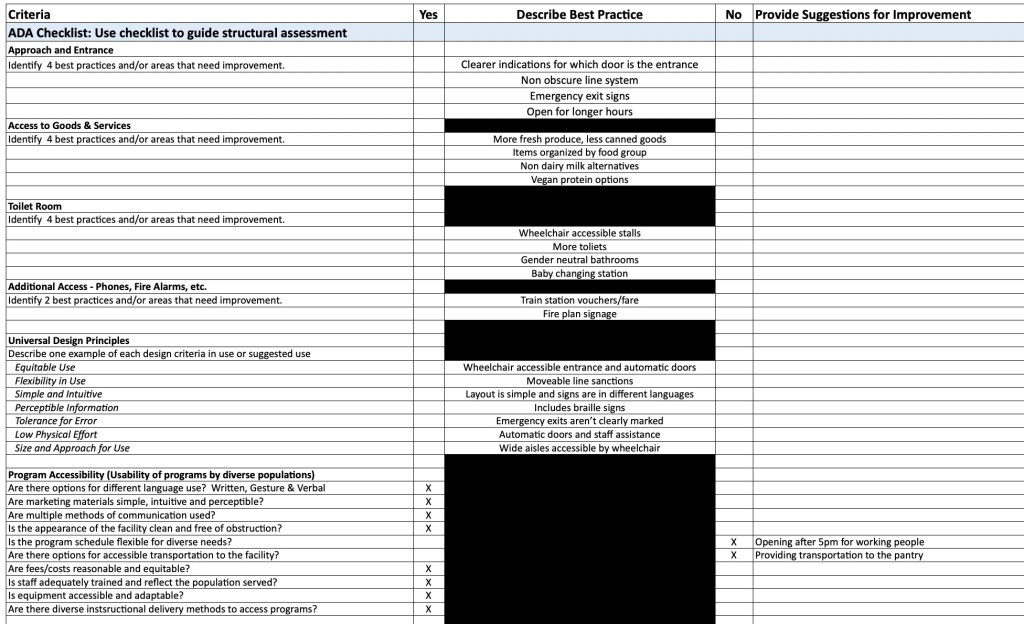
From my structural assessment of the Catholic Charities Boston facility, it shows many accessibility practices in action as well as some areas for improvment. At the entrance, the organization has automatic doors as main entry points, however the building has many entrance points making it difficult to tall which is the main one. The facility has wheelchair accessible entrances, ramps, and automatic doors, which are all ADA compliant for disabilities.
Inside, the food pantry areas their are canned goods, a few fresh produce, and frozen meat. Some room for improvement may include providing vegan meat and non dairy options. I think these small incorperations would be more cultural inclusive, for vegans/vegetarians or dietary restrictions.
The restroom areas were small with a single stall and sink. Some potential improvement areas could be adding wheelchair accessible stalls, gender neutral options, and baby changing stations, to provide access to everyone.
Some additional things to work on include marking emergency exits more visibly, and having a plan for evacuation. Opening up after 5 PM could also increase accessibility for people that work between their current hours of 9AM-1PM. These changes would provide more inclusivity and provide support to even more people..
Program Accessibility
Accessibility at Catholic Charities Boston is strong in many ways. The program has bilingual staff that speak English, Spanish, and Portuguese, the three most common languages in that community. Marketing materials are simple, the facility is clean with an open layout for wheelchairs to move.
However, there are areas for improvement when it comes to accessibility. For example transportation barriers; with the building’s proximity to the train station they could provide transportation vouchers or shuttle services for clients who live farther away. Expanding to include evening hours would also better serve working people who don’t have time to go during the day.
Overall, they have strong efforts to create a welcoming environment for people of different backgrounds, this lines up with the inclusive leisure and nonprofit service delivery principles (The Planning Process, 2013).
Universal Design Assessment
Reflection
Accessibility at Catholic Charities Boston is strong in many ways. The program has bilingual staff that speak English, Spanish, and Portuguese, the three most common languages in that community. Marketing materials are simple, the facility is clean with an open layout for wheelchairs to move.
However, there are areas for improvement when it comes to accessibility. For example transportation barriers; with the building’s proximity to the train station they could provide transportation vouchers or shuttle services for clients who live farther away. Expanding to include evening hours would also better serve working people who don’t have time to go during the day.
Overall, they have strong efforts to create a welcoming environment for people of different backgrounds, this lines up with the inclusive leisure and nonprofit service delivery principles (The Planning Process, 2013).
References
Simmons, R. C., & Patterson, D. G. (2020). Community development: Applications for leisure, sport, and tourism
D. R. Austin & Y. Lee (2013) Inclusive and special recreation: Opportunities for diverse populations to flourish


 Olympia Dorsey